Emergency
Community notice
In the emergency department, the most urgent cases are treated first.
In the emergency department, patients are not seen on a first-come, first-served basis. Every patient is assessed upon arrival and assigned a triage level using a nationally recognized five-level triage scale. This assessment helps determine the urgency of each patient's condition and ensures that the most urgent cases are treated first.
As a result, someone who arrives after you may be called before you if their condition requires more immediate attention. Triage is designed to ensure safe care based on the severity of each patient's condition and the level of risk involved.
Every patient undergoes a triage assessment. Understanding how triage works also means understanding why the order in which patients are seen may differ from the order in which they arrive.
Short version
In the emergency department, patients are prioritized based on the urgency of their condition, not simply on their arrival time. Every patient is assessed using a nationally recognized five-level triage scale to help ensure that the most urgent cases are treated first.
Radio script
In the emergency department, the first person to arrive is not always the first person to be seen. Every patient is assessed using a nationally recognized triage scale that helps determine the severity of their condition. Someone who arrives after you may be called before you if their condition requires more immediate attention. Triage is in place to help ensure everyone's safety.
Community notice
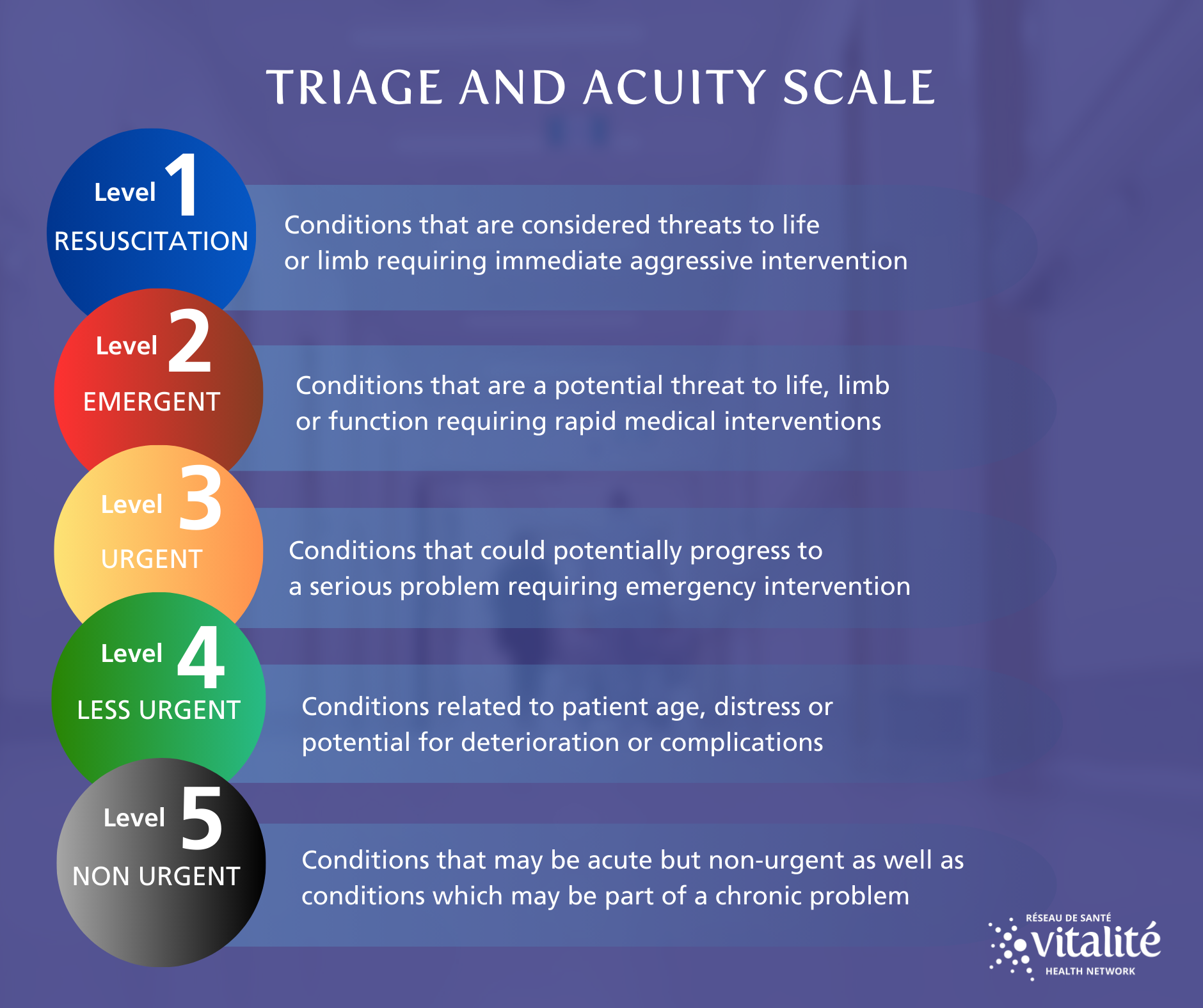
A five-level classification system for determining the degree of urgency.
The triage scale used in the emergency department has five levels:
- Level 1 – Resuscitation: Conditions that threaten life or limb and require immediate intervention.
- Level 2 – Emergent: Conditions that threaten life, limb, or function and require rapid medical intervention.
- Level 3 – Urgent: Conditions often associated with significant discomfort and an inability to perform activities of daily living.
- Level 4 – Less urgent: Conditions that may deteriorate or result in complications.
- Level 5 – Non-urgent: Conditions that may be acute but non-urgent or related to a chronic health issue.
This classification helps emergency department staff determine which patients need to be seen first.
Short version
The triage scale in the emergency department has five levels, ranging from “Resuscitation” to “Non-urgent.” This classification allows patients to be prioritized based on the severity of their condition and the risk of deterioration or complications.
Radio script
Did you know that emergency department triage uses a five-level scale to prioritize patients? Level 1 is reserved for situations requiring immediate intervention, while the remaining levels identify conditions that are emergent, urgent, less urgent or non-urgent. This scale helps staff prioritize care and ensure that the most urgent cases are treated first.
Community notice
In the emergency department, severity determines priority.
It can be difficult to wait when you’re not feeling well. However, the order in which patients are seen is based on the triage level assigned to each patient.
Patients with conditions that pose a threat to life, limb, or function, or that require immediate or rapid intervention, must be treated first. Other situations may be classified as urgent, less urgent or non-urgent.
Triage helps ensure that care is prioritized according to the severity of each patient's condition.
Short version
Did someone who arrived after you get called before you? In the emergency department, priority is based on triage level and the severity of a patient's condition, not simply on arrival time.
Radio script
Why might someone who arrived after you be seen before you in the emergency department? Because every patient is assessed through triage based on the severity of their condition. Life-threatening situations or those requiring immediate care are given priority. Triage helps ensure that the right care is provided to the right patient at the right time.
Community notice
Is your condition getting worse? Ask to be reassessed.
The triage level assigned to you is based on your condition at the time of your assessment. However, your condition may change while you are waiting to see a health care professional.
If your condition worsens after your initial assessment, notify emergency department staff immediately. A reassessment may then be performed to account for any changes in your condition.
Do not remain silent if your condition changes. Let emergency department staff know.
Short version
Has your condition worsened while waiting in the emergency department? Notify the staff immediately and ask to be reassessed. Your triage level should reflect any changes in your condition.
Radio script
Your condition may change after your initial emergency department assessment. If your condition worsens while you are waiting, notify staff immediately and ask to be reassessed. Triage is used to determine how urgent your situation is, and that assessment should reflect any changes in your condition.
Community notice
For less urgent situations, other care options may be available.
The emergency department is intended for situations that require immediate or rapid medical attention. Some health concerns, however, may be assessed as less urgent or non-urgent.
Depending on your condition, other health care options may sometimes be better suited to your needs. Vitalité Health Network invites you to visit its website to determine the care pathway that is most appropriate for your situation.
Choosing the right care pathway can help you access the care that best matches your needs.
Short version
Not every health concern requires a visit to the emergency department. For less urgent conditions, other care options may be available. Visit Vitalité Health Network’s website to find the care pathway that is most appropriate for your situation.
Radio script
A visit to the emergency department isn’t always the only option. Some less urgent or non-urgent situations can be cared for elsewhere, depending on your needs. To find the care pathway that is most appropriate for your situation, visit Vitalité Health Network’s website.
Community notice
Respect helps keep everyone safe.
Waiting in the emergency room can be difficult, especially when you’re worried about your health or that of a loved one. However, staff must follow the triage process to ensure that the most urgent cases are treated first.
Vitalité Health Network reminds everyone of the importance of treating staff and the triage process with respect. Triage helps ensure that patients are prioritized according to the urgency of their condition.
Treating everyone with respect contributes to a safe environment for patients, families and health care workers.
Short version
In the emergency department, triage ensures that the most urgent cases are treated first. Respecting staff and the triage process helps keep everyone safe.
Radio script
Waiting in the emergency department can be difficult, but staff must follow the triage process to prioritize people whose conditions require immediate or urgent care. Vitalité Health Network reminds everyone of the importance of treating staff and the triage process with respect. Respect is essential to maintaining a safe environment for all.
Other resources
Health and health care matter to everyone. Let’s keep the conversation going in our communities.
